
Words and images Vicki Ravlich-Horan
A map of Emilia Romagna reads like a shopping list. This food mecca is the home to many of the foods synonymous with Italy, from Bolognese to Parmigiana, balsamic vinegar to prosciutto.
Bologna, the region’s capital, is the heart of Italian cuisine, but surprisingly often left off tourists’ itineraries. But not this gastro nomad’s itinerary! In fact, this town and those surrounding it offer so much to taste, Bologna was our base for four nights. And while I was there to discover why the town is often called La Grassa (the fat one), I also discovered why it’s also known as La Rossa and La Dotta.
By Italian standards, Bologna is more a town than a city and has a very chilled vibe compared to the metropolis of Milan, where we eventually ended our gastronomic tour, having stopped along the way at wineries, and cheese and ham factories, venturing south to the Piedmont region to enjoy truffles and hazelnuts before driving north, stopping in Turin and then driving through the rice paddies of Vercelli.
La Dotta (or the learned one) comes from the fact that Bologna is the home to the world’s oldest university, dating back to the 11th century. (The ‘world’ claim may not be totally accurate, but it is the oldest in Europe.) The many students add a young, vibrant vibe to the town, especially at aperitivo hour.
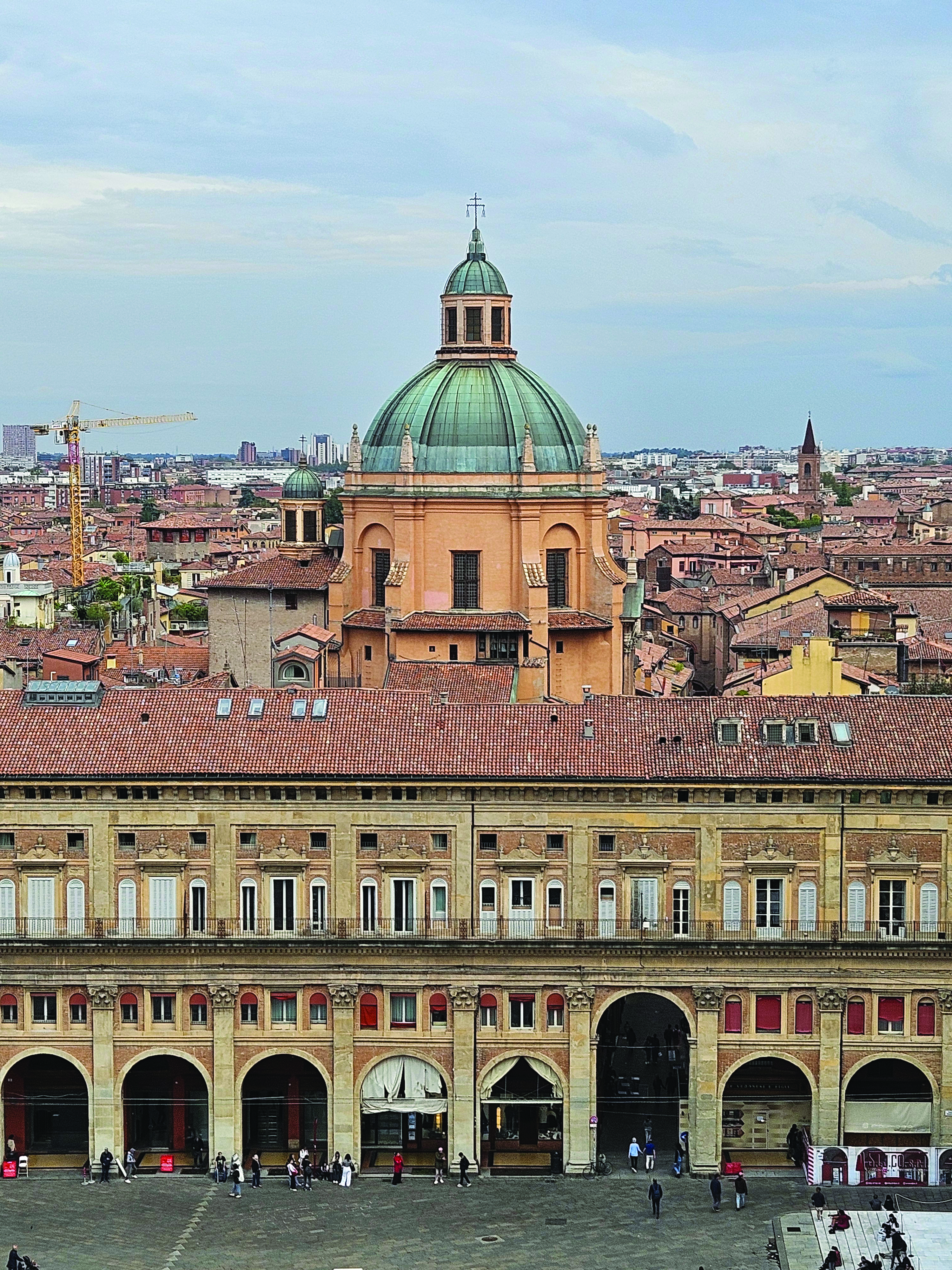
La Rossa comes from the red-brick buildings, and there is no better way to take the beauty of these in than to climb one of the towers. Built in the Middle Ages, these towers were used as a form of defence as well as a symbol of prestige by wealthy families. Bologna once boasted over 100 towers, today just 28 remain. The most famous are the Torre degli Asinelli and Torre Garisenda in the centre of the city.
Torre degli Asinelli, at 97 metres tall, is the highest authentic medieval tower in Italy. Sadly for us it was closed for repairs so we didn’t have the option to climb. But if you saw the lean of Torre Garisenda beside it, you would not begrudge such repairs.
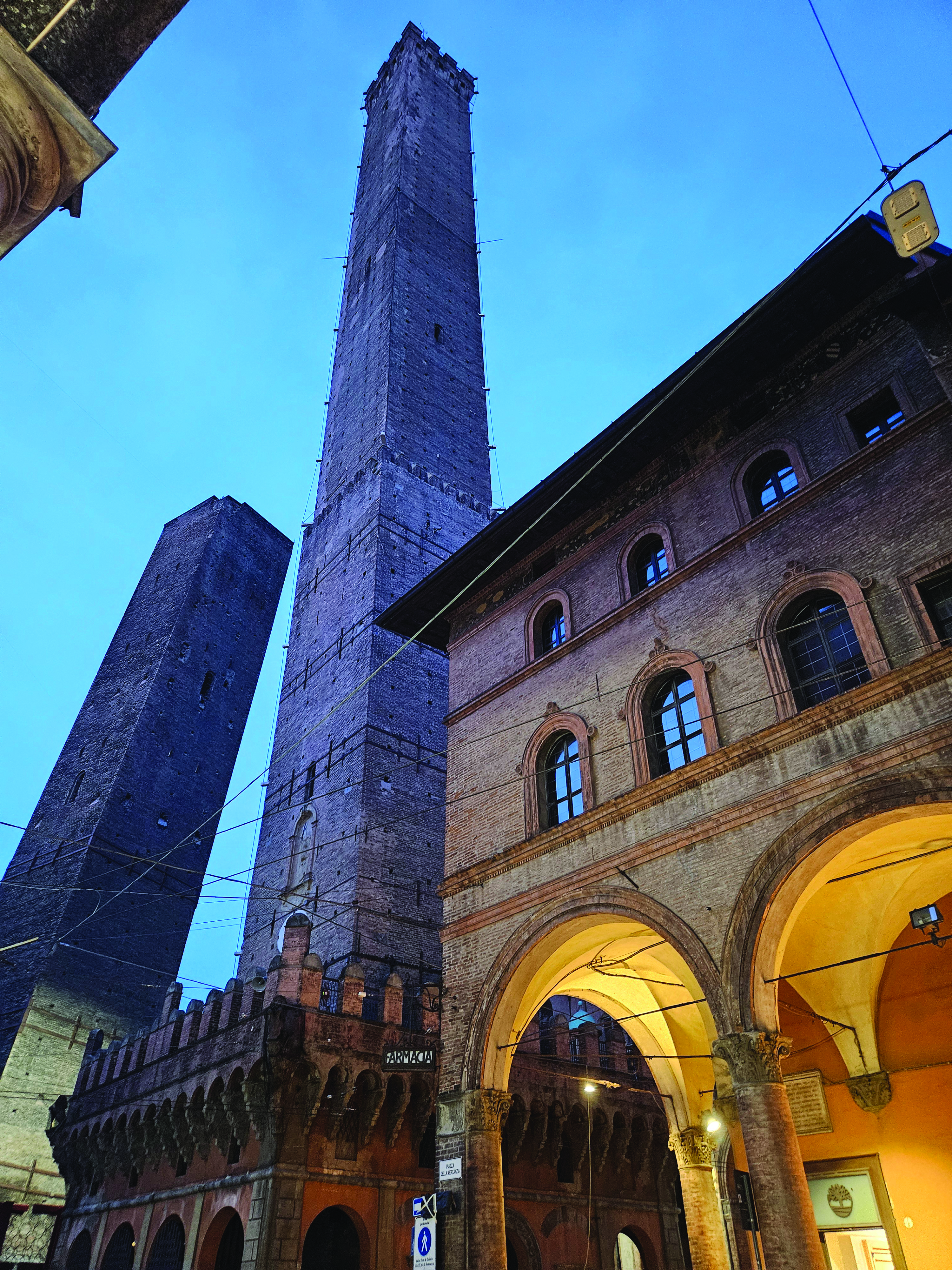
Visitors have a number of alternatives if they are keen to climb the heights of Bologna. The San Pietro Bell Tower, the second tallest tower in Bologna, is built on a pre-Christian tower inside San Pietro Cathedral and comes with an interesting history as well learning the unique local way of bell ringing or ‘alla Bolognese’.
The San Pietro Bell Tower is only open a few hours each afternoon, so we opted to climb the clock tower of Palazzo d’Accursio, which includes admission to the city’s vast art collection. Although only 36 metres tall, you are rewarded with beautiful views of the red city and beyond for only half the climb.
Bologna’s medieval cobbled streets are almost void of cars, as students, workers and families alike opt to walk or use bikes to get around. And all roads lead to Piazza Maggiore, the town square and the perfect spot to stop and watch the world go by, be it with a coffee or aperitivo.
At the centre of the square sits the striking Basilica di San Petronio. Striking for several reasons, partly for its size, partly for its legendary facade that was left unfinished when a 16th-century pope decided it would outshine St. Peter’s Basilica in Rome and halted its completion.
Stepping inside, it was hard not to be awe-inspired by its sheer size. The pope may have had a point. I couldn’t help but think this feeling of awe was due to the relatively plain interior allowing you to take in the scale. I say this because Basilica di San Petronio is smaller than the famous Duomo in Milan, but when you step inside that church it is the razzle dazzle of the art and decorations that capture you, not the scale of the building.
Basilica di San Petronio, which incidentally is not the official city cathedral, is home to the world’s longest sundial. Installed by the astronomer Cassini in 1655, the midday sun shines through a hole in the ceiling down onto the meridian line on the church floor indicating noontime every day and what day of the year it is in the Gregorian calendar. During the Middle Ages this is what the Vatican used to determine the date for Easter Sunday.
Basilica di San Petronio is the tenth biggest and the largest brick gothic-style church in the world.
Along with the towers, Bologna is known for its many porticoes, 40 kms of them in the city centre. Dating back to the 12th century, they were a way for building owners to extend their real estate over the public walkways. They vary in size and design from the austere to the elaborate. And as we found out, they also make walking around Bologna in the rain a lot easier!
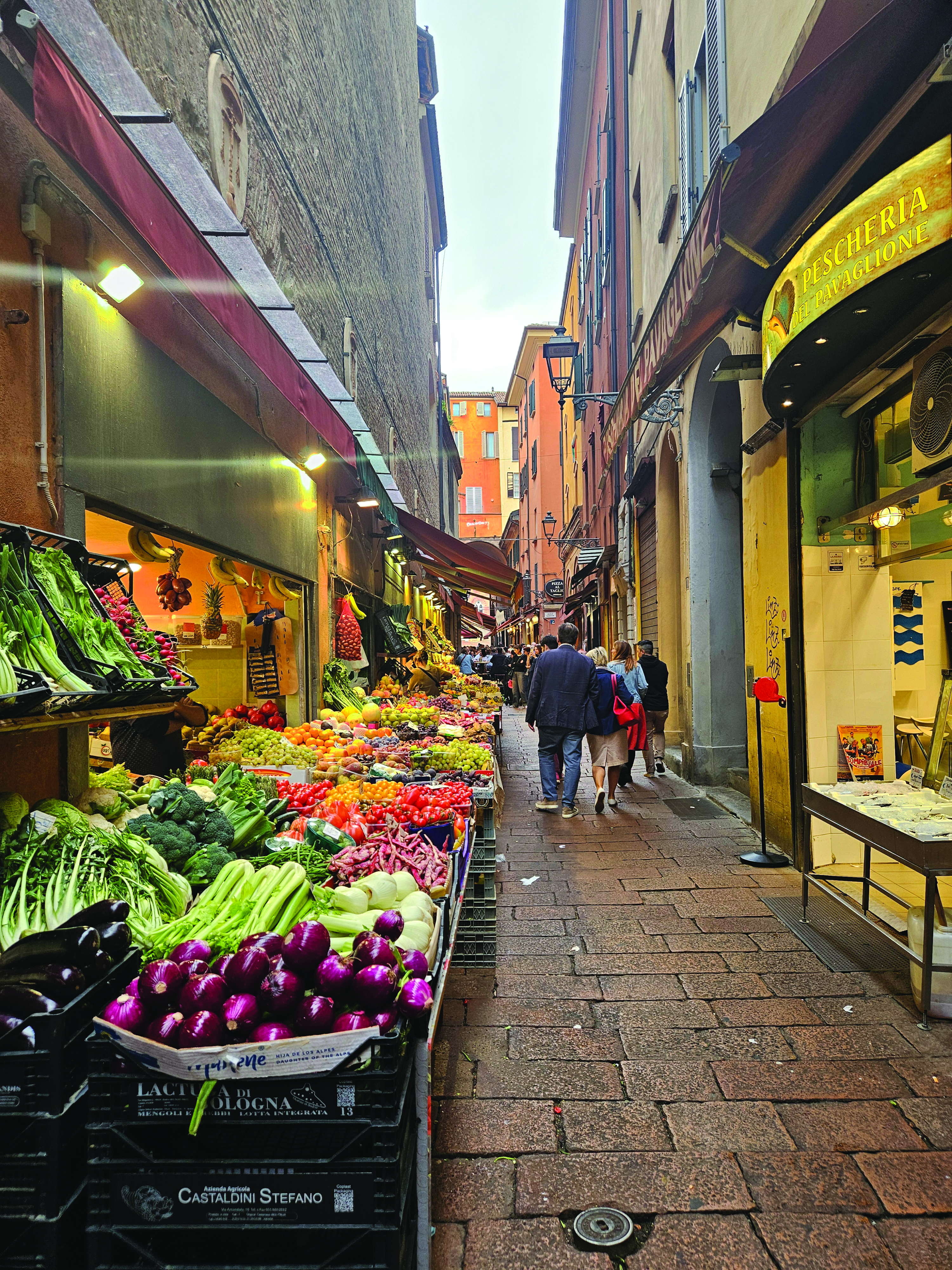
Veer off the porticoes around Piazza Maggiore and down the medieval alleys of the Quadrilatero and be rewarded with the flavours of Bologna and the surrounding region.
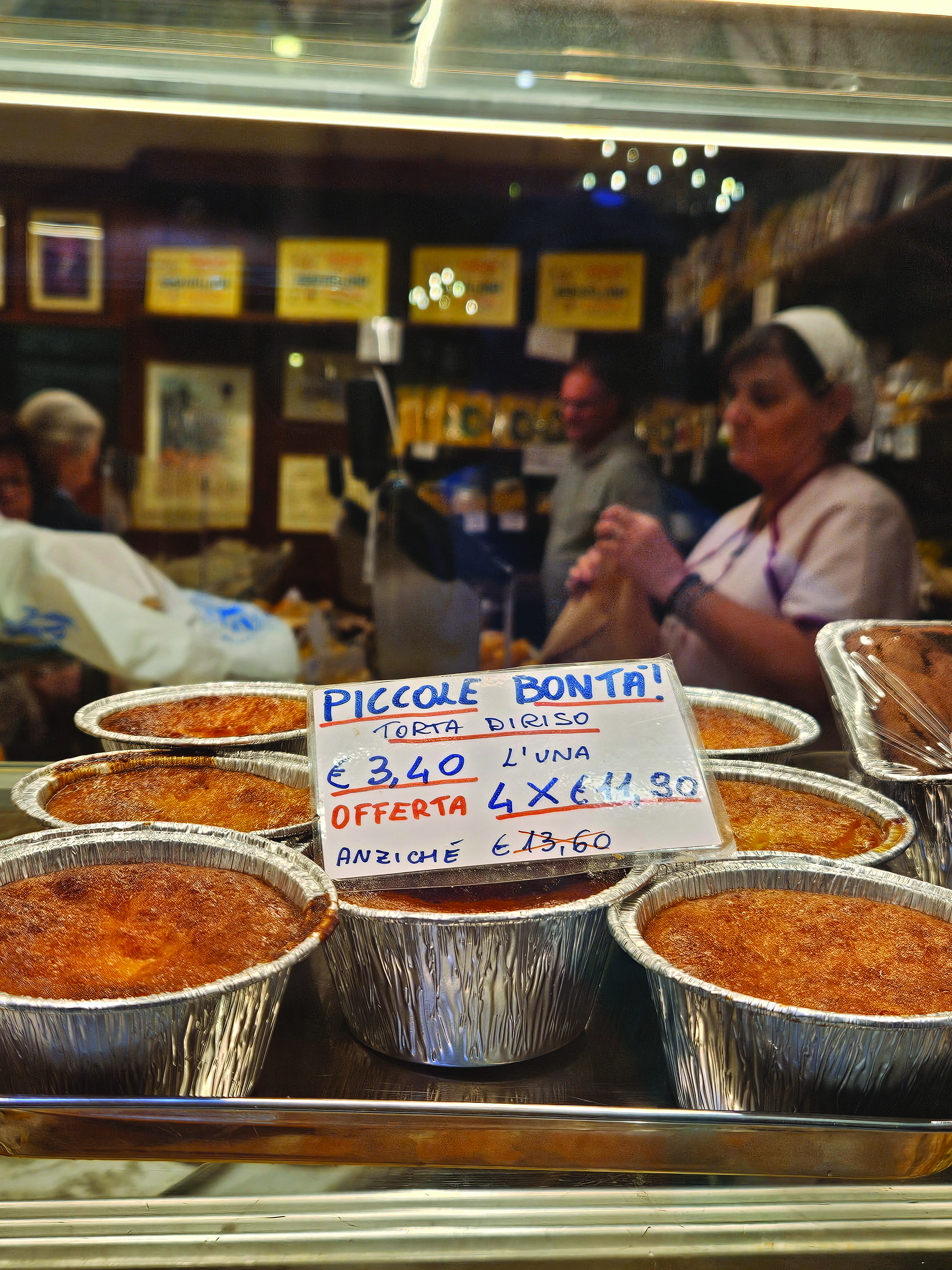
Amongst these tiny streets is Paolo Atti & Figli, the oldest bakery in Bologna. Here the window display, complete with handwritten signs, are filled with tempting traditional sweet treats.
We walked into Drogheria Gilberto to sample some local chocolate but were drawn down to the cellar by the thousands of Italian wines on offer. Talking of wine, a traditional osteria was a place that served drinks, a place to go and play cards and have a glass of wine, where today an osteria often means restaurant. But food was never the focus back in 1465 when Osteria del Sole opened. In the heart of the Quadrilatero you can step back in time and enjoy a drink at Osteria del Sole, the oldest osteria in Bologna, possibly Italy. If you want to eat it’s strictly BYO food.
If food is what you are after, there are many great options. Stop at one of the delis with tables spilling out onto the pavement. Enjoy tagliere, a board filled with local cured meats and cheese, often served with the local bread tigella, with a glass of local wine like the sparkling red, Lambrusco.
This is a wonderful way to soak up the atmosphere and enjoy a taste before venturing beyond Bologna to the neighbouring towns of Modena, Parma, Asti and beyond, where you can discover the traditional artisans making these products in the age-old way.
Specialists in the best regional products, we stopped at Salumeria Simoni for an aperitivo and stayed to enjoy our first bite of the real deal lasagne alla Bolognese.
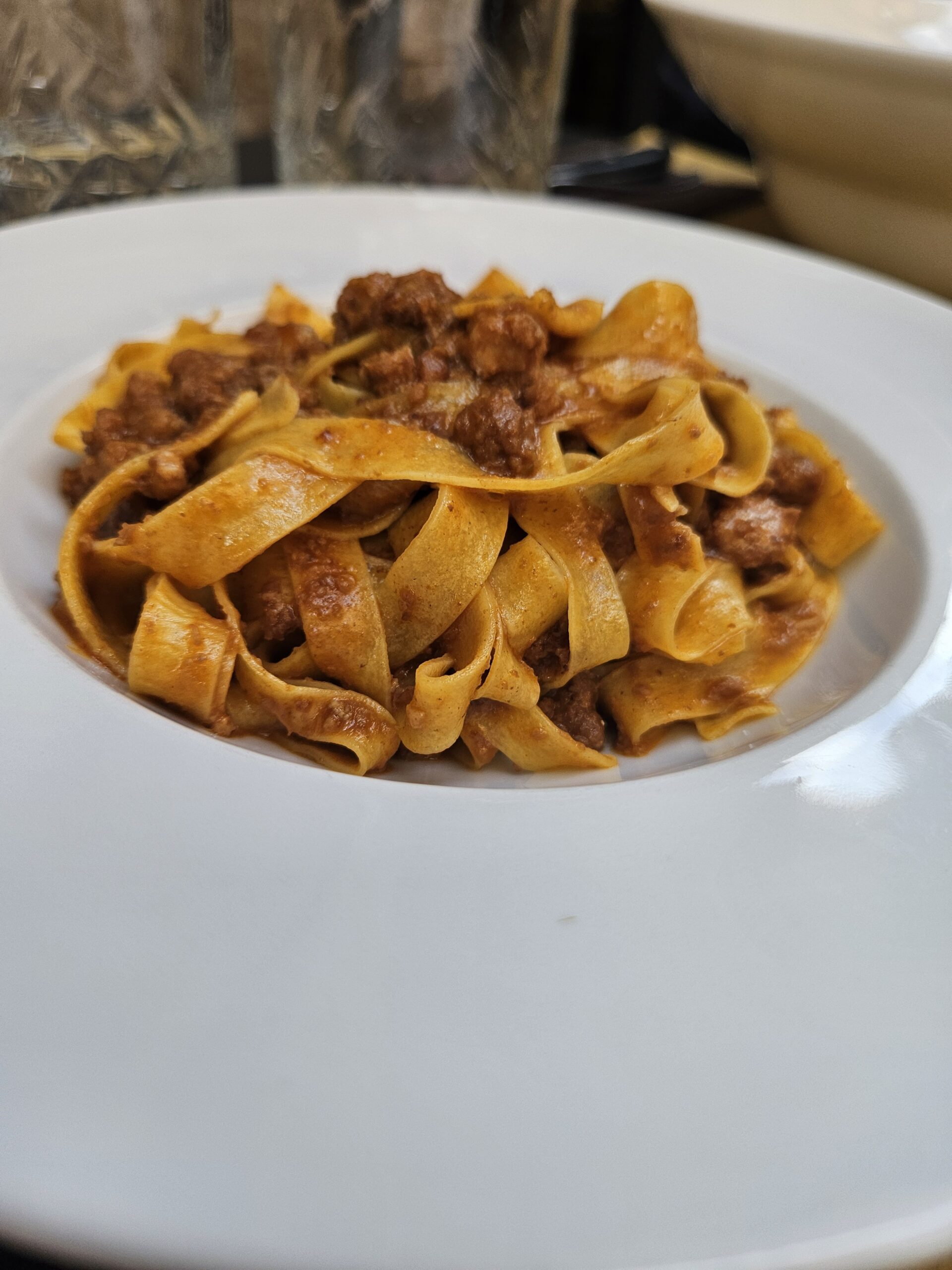
The official recipe for lasagne, which consists of fresh spinach pasta, ragu and bechamel, is held in the Bologna Chamber of Commerce. Bologna, also the birthplace of Bolognese (they call it ragu) is all about fresh pasta. This means you will never find spaghetti Bolognese on a menu, instead it is always served with tagliatelle.
Fresh pasta is such a big deal here many eateries or delis make it behind their front windows to prove it is made fresh and on the premises. For me, the revelation was tortellini in brodo – beautiful fresh tortellini served in a clear broth.
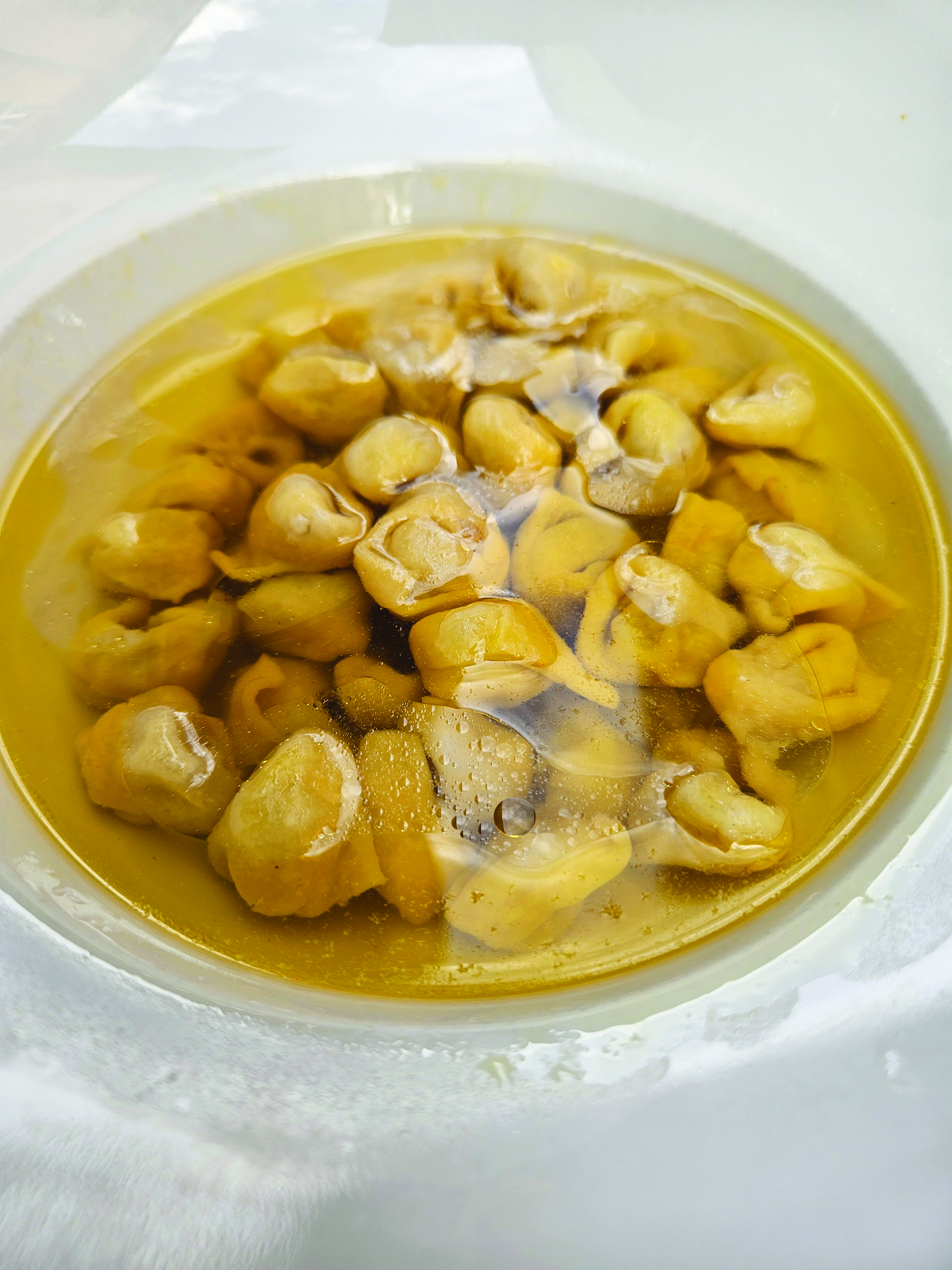
Supposedly inspired by Venus’s belly button, tortellini hail from Emilio Romagna. Some claim from Modena, others Bologna – so I tried the dish in both towns and enjoyed them equally. The tortellini are filled with local delicacies of pork, prosciutto crudo, mortadella and Parmesan cheese.
Before venturing further into the region of Emilia Romagna, there was just one more delicacy to try – mortadella. Considered the most famous cured meat from Bologna, mortadella has recently grown in popularity around the world where most of us grew up with its very poor cousin, bologna.

Mortadella was one of the first foods to have its uniqueness tied to its region of origin, now a PGI (protected geographical indication). It is made using mainly pork shoulder meat which is minced and mixed with lardons of fat from the pig’s neck and spices. The sausage is then slowly cooked for several hours until the middle reaches 70°C.
For a modern yet authentic mortadella experience, Mo Mortadella Lab is the place to go. Their hole in the wall sandwich shops serve up all manner of mortadella sandwiches.

Taste of Northern Italy Tour 2025
Bologna was a treat and a town I can’t wait to go back to and discover more! If you are keen to join me our Taste of Northern Italy tour, it begins in Bologna. From Bologna we will travel through the towns of Modena, Parma, Asti and Alba before we reach Turin then Milan. Along the way we will discover some of Italy’s iconic food and wine, all while enjoying great company in our small group tour.
Email me vicki@nourishmagazine.co.nz for more information.